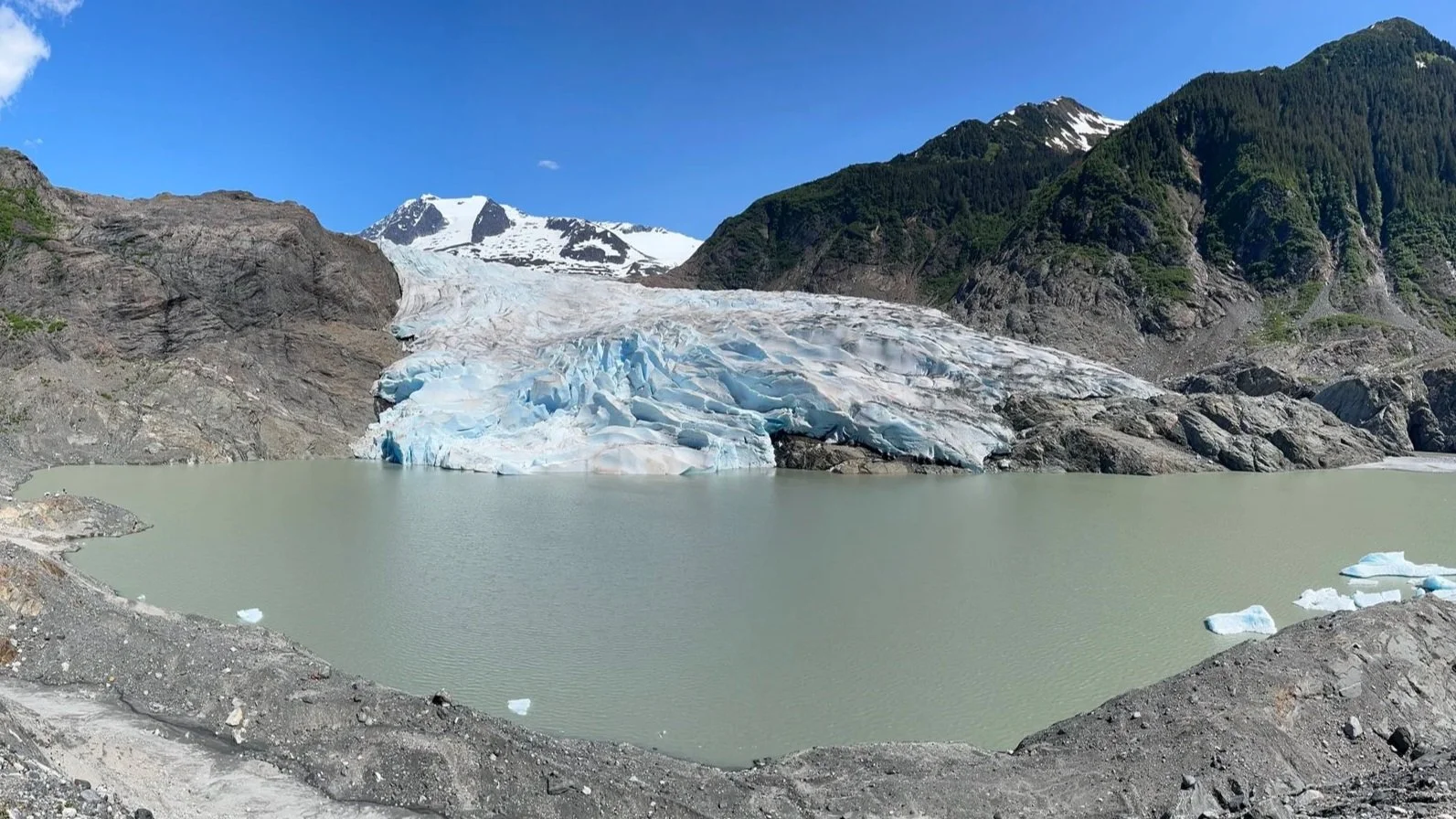
Proglacial lakes & glaciers
As the number and area of proglacial lakes increases worldwide, we are investigating how these lakes affect the frontal ablation (melt and calving of icebergs) of the glaciers draining into them. Does the lake matter? Are there general characteristics of lakes worldwide we can identify? We explore those fundamental questions at various time and space scales with a focus on understanding the processes that underpin water/ice coupling in these systems.
Proglacial Lake Observations
We have collected hydrography and turbidity data at a number of lakes including ones in Southeast Alaska (Gilkey, Shakes, and Mendenhall). We are working towards comparing these data with other proglacial lake observations worldwide, e.g., from Patagonia, New Zealand, and elsewhere in Alaska. Part of this work is supported by a 2023 NSF grant.
Multibeam Sonar
We have collected imagery of the underwater portions of alke-terminating glacier termini and the lake bathymetry as well. The morphology of the glacier and the geometry of the lake play a fundamental role in shaping the thermal stratification of the lake, with implications for downstream effects on temperature, sediment, and ecosystems.
Sediment is a significant factor in controlling the circulation in these lakes, so we are actively looking into how to couple lake circulation models with sediment dynamics and a thermodynamically active glacier face. There are parallels again with the ice-ocean world, but without salinity effects, temperature and sediment concentrations become relatively more important.
Numerical Simulations
Funding and Collaborators
Funding for this work has come from NSF and the University of Oregon. We have benefited from numerous collaborations with scientists from around the world. Some are listed here:
Jason Amundson, U Alaska Southeast
Billy Armstrong, App State Univ.
Eran Hood, U Alaska Southeast
Irina Overeem, CU-Boulder
Heather Purdie, U Canterbury (NZ)